1.4 EHI Connection and Messages
The External Host Interface messaging system is based on RESTful principles. The API accepts JSON-encoded request bodies and returns JSON-encoded responses. The API uses standard HTTP Response codes and verbs. All requests to the API must be made over HTTPS.
See the figure below, illustrating the Thredd system components and typical message flow.
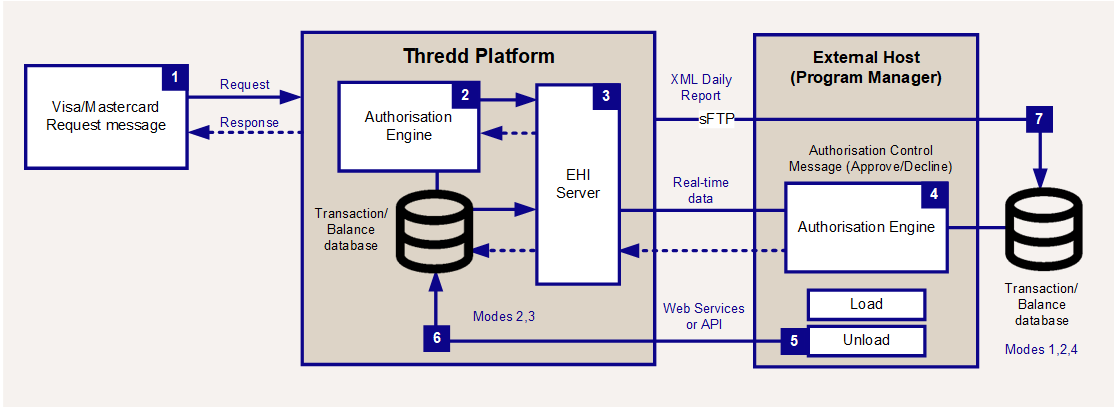
Figure 6: Thredd System Components and External Host Interface Message Flow
Below is a generic summary of this process, which may differ depending on your EHI mode. For more information, see EHI Operating Modes.
-
The card scheme
 Stage where a merchant requests approval for a card payment by sending a request to the card issuer to check that the card is valid, and that the requested authorisation amount is available on the card. At this stage the funds are not deducted from the card. requests, as well as batch clearing file and financial transaction notifications to Thredd.
 -
The Thredd Message Processing System (MPS) performs authentication, validation, velocity controls, fraud protection and product configuration checks.
-
The EHI server sends the card transaction requests and any financial notifications to the external host URL endpoint configured for your programme.
-
Depending on your EHI mode, Thredd may be involved in the card transaction approval decision. For example, in EHI mode 1 (Gateway Processing), mode 4 (Gateway Processing with STIP) the external host (i.e., Program Manager's systems) decides whether to approve or decline the transaction, by checking details of the balance held on the card. In EHI mode 3 (Full Service Processing) Thredd makes the approval decision.
-
The EHI server waits for an approve or decline response or a financial message acknowledgement from the external host. When received, this is processed. Card transaction decline or approve responses are forwarded to the card scheme.
-
Where Thredd maintains the balance on the card, the Program Manager can perform load and unload transactions via the Thredd web services, to update the balance (for details, refer to the Web Services Guide).
-
In addition to the real-time data feed, Thredd also provides a daily batch XML transactional data feed via sFTP
Secure File Transfer Protocol. File Transfer Protocol FTP) is a popular unencrypted method of transferring files between two remote systems. SFTP (SSH File
Transfer Protocol, or Secure File Transfer Protocol) is a separate protocol packaged with SSH that works in a similar way but over a secure connection.. You can use this data to support your payment reconciliation process.
Due to the real-time nature of authorisation or online financial requests, in EHI modes where your systems need to process the request, they must respond within the configured time limit for a request (see EHI Configuration Options) or the transaction will be declined.
1.4.1 Types of EHI Messages
EHI sends the following types of messages to the external host (Program Manager's systems):
-
Real-time authorisation requests - which require an immediate approve or decline decision and response. If not responded to in time, Thredd or the Card Scheme may provide Stand-In Processing (STIP)
-
Real-time reversal requests - which require an immediate acknowledgement
-
Real-time advices - which require an immediate acknowledgement (e.g, authorisation advices)
-
Financial notifications - such as presentments and chargebacks. These require an acknowledgement. An additional response status is optional.
-
Cut off messages (optional) - batch report showing all messages you should have received in a defined period. See Cut Off Messages.
For most message types, EHI waits for an acknowledgement from the external host to confirm that the message has been received. If no response is received, EHI resends the message. See Processing EHI Transactions.
For details of the fields included in each type of transaction, see EHI Data Feeds.
1.4.2 Transmission Control Protocol (TCP) Connection
For each message sent via the EHI, the following occurs:
-
The EHI makes a TCP connection to the external host URL configured for your program. Thredd is always the TCP client, the external host (your system) is always the TCP server.
-
Using the HTTP POST method, EHI sends an HTTP message to this TCP connection with the SOAP XML message as the message body. The message body is XML encoded to the UTF-8 format. See https://www.w3.org/TR/REC-xml for specifications.
-
The response from your system must be a valid HTTP response with the HTTP response body containing the valid XML response data.
-
In the production environment EHI uses Thredd's Trust Framework, which leverages the Mutual Transport Layer (mTLS) protocol. .
1.4.3 mTLS Connection
EHI uses Thredd's Secure Connectivity Framework, which leverages the Mutual Transport Layer (mTLS) protocol. You will need to set up your mTLS termination point to validate the mTLS Transport Certificates. For more information, see the Connecting to Thredd Guide.